Roof cleaning and facade washing
Low pressure and the right product: the dirt goes, the covering stays intact.
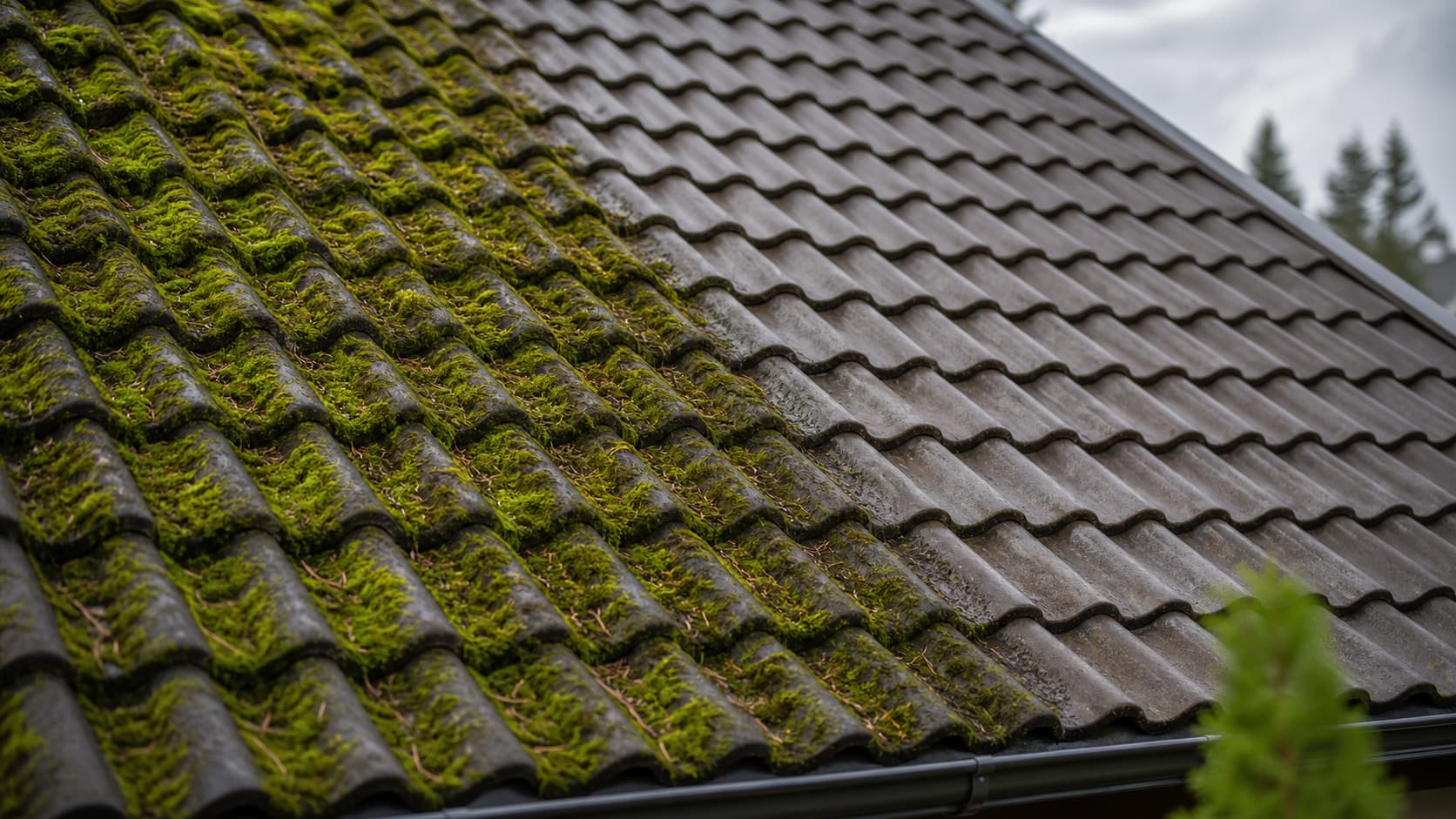
Washing a roof or a facade means something different from washing paving. Dirt comes off paving by force; off a roof you are taking away a living organism — moss, algae and lichen — while leaving the covering itself intact. Force does harm here faster than good: a roof covering is a surface a couple of millimetres thick that has to last decades more, and one morning of hard pressure washing can shorten that.
We wash roofs and facades in Tallinn and Harju County: sheet metal roofs, concrete tile, bitumen shingle, rendered and timber facades, plinths and rainwater systems.
A roof is not washed at paving pressure
Roof covering manufacturers say so themselves, each about its own material.
On concrete tile Benders writes it plainly: high-pressure washing wears the outer surface of the tiles heavily and causes damage through too much pressure and rotating nozzles. Katepal, the bitumen shingle maker, is shorter still: a pressure washer must not be used on a bitumen roof. Ruukki, the steel roofing manufacturer, allows a pressure washer but sets a limit, up to 50 bar, and recommends a soft brush and water first for removing dirt. That 50 bar is the only figure any manufacturer has published for roof washing; for the other materials the instruction comes in words, not in bar.
The roofing manufacturer BMI warns in turn that a high-pressure washer should be used very carefully, especially on older roofs, that you must always move in the direction of the pitch, and that excessive force and wire brushes are to be avoided.
That is where our method comes from: the surface is cleaned at low pressure, and the work is done by the product made for it, not by the water jet. Water always goes from the top down, and the Ruukki instruction explains why: water aimed downwards does not push itself under joints and penetrations, water aimed upwards does, and then the roof leaks.
Each covering needs its own method
Sheet metal roof. Soft brush, water, a roof cleaner made for painted surfaces where one is needed, pressure kept within sensible limits and movement from the top down. At the end the roof is rinsed off so no detergent is left, and the rainwater system is flushed through too. Individual stubborn stains can be rubbed off with a cloth moistened in white spirit, the Ruukki instruction says.
Bitumen shingle. Here pressure washing is not on the list at all. The covering is cleaned with a brush and a wash made for the purpose, and the manufacturer already assumes one pass may not be enough: Katepal writes of two or three treatments about two to three weeks apart.
Concrete and clay tile. Loose growth is swept off and the surface is treated with a moss and algae product. The result does not come the same day. By the manufacturer's own account, after a couple of months you see the remains of withered algae and moss, which rain and wind carry away over time, and lichen usually takes longer to go. Anyone who promises a concrete tile roof clean in a day is either washing it under pressure or has not looked at the roof.
Moss and algae products are biocides. Terviseamet, the Estonian Health Board, states it in one line: only biocides holding an authorisation under the EU biocidal products regulation or a registration certificate under the Estonian biotsiidiseadus may be sold and used in Estonia, and the authorisation number has to appear on the label. Those are the only ones we work with, in the dose and by the method the manufacturer prescribes.
What moss actually does to a roof
Green cover is not only a matter of appearance. BMI sets out the mechanism: moss binds moisture, and where there is a lot of it on a roof it can add excess load to the roof structure; in the winter freeze-thaw cycle that can produce microcracks and speed up the wear of the roofing material. On a bitumen roof there is one thing more: moss roots can penetrate the surface layers of the bitumen material and cause cracking and moisture damage. A metal roof does not absorb moisture, but moss collects dirt on it and holds water on the surface.
So moss does not ruin a roof in one season. It shortens its life quietly, and all the time.
Facades: render, timber and panel
On a facade the visible problem is usually mould, algae and street dust, and there the chemistry does even more of the work than on a roof. The Tikkurila work instruction holds the whole logic in one sentence: the solution goes on with a brush, or on a large surface with a garden sprayer, working from the bottom up; it has to act on the surface for at least half an hour; then the surface is brushed and rinsed with water from the top down; and if a pressure washer is used for rinsing, at low pressure and for longer. One more rule separates good work from bad: the wash must not dry on the surface.
Bottom up, so that the solution does not run down a dry surface in streaks that leave marks. Top down when rinsing, so that the dirt travels downwards instead of settling on what has already been washed.
Where facade washing is preparation for painting or impregnation, the next step has conditions of its own: for painting a timber facade Tikkurila requires an air temperature of +5 to +28 °C and humidity up to 80%. Which is why there is no sense washing two days before a cold spell if painting is to follow straight away.
The gutters belong to the wash
The gutter is where roof maintenance most often stops half-finished. Two sentences in the Ruukki instruction say everything: rain generally washes the heavier dirt off, but rain alone cannot be relied on; branches and sodden leaf litter have to be cleared out of the gutters as well, because they too are a good place for moss to grow. Add to that a blocked gutter, which leaves water at the eaves and against the wall and feeds exactly the damp that produced the moss in the first place.
The same instruction advises cleaning the roof and the gutters at least once a year, once most of the leaves are down, and assessing the general state of the roof covering visually at least once a year. Autumn leaf clearance and flushing the gutters are therefore one job, not two.
Working at height is a separate job
Safety on a roof wash is not advice, it is a regulation. The Estonian occupational-safety rules for construction work set out measures against falls from a fall height of more than two metres, and give roof work its own lines: where the roof pitch is under 15° and the eaves higher than 3.5 m above ground, a guardrail with three horizontal rails has to be fixed to the roof edge; where the pitch is 15° or more and the eaves higher than 2 m, a guardrail or a safety net goes on the edge, and on a slippery roof the work area is covered with roof ladders set 30 cm apart; from 34° upwards a further guardrail or net is required no more than 5 m from the work area.
In practice that means we look at the roof pitch, the height of the eaves and where a machine or scaffolding can reach at all before we give a price. Where there is no access, we say so then, not on the day of the work.
When to wash in Estonia
The window is shorter than it looks. The manufacturer of the moss and algae product forbids two things at once: treating in direct sunlight and treating frozen surfaces. By the Tallinn-Harku climate normals the mean minimum temperature is already close to zero in November and below zero from December to March. That leaves spring, summer and early autumn, preferably a cloudy day or a morning.
The bitumen shingle manufacturer recommends checking the state of the roof twice a year, in spring and in autumn. That is also the right moment to decide whether the roof needs a wash or clearing the gutters is enough.
How the work runs
We start by looking: which covering, how old, what pitch, where the access is, whether a tile or a shingle has already moved. The method follows from that, and only then the price. On the day we cover plants, entrances and machinery, because wash water and product must not land wherever they please, and we send the water where it belongs on the plot.
After washing we flush the rainwater system, clear away the loose material and show you the result. If something turned up on the roof that is not a washing matter — a loose sheet, a broken penetration, a rusted fixing — we say it out loud, even when we are not the ones doing that work.
The same logic holds at ground level: pressure washing paving and terraces runs at different pressures, and washing a timber terrace together with oiling is described under terrace maintenance.
How often should a roof be washed?
It depends on shade and trees. An open, sunny roof can go ten years before anything shows; a north-facing slope under tall deciduous trees grows moss several times faster. Clearing leaves off the roof and out of the gutters is an annual job in any case. We have written at more length about what moss does to a roof and when to step in: moss on the roof.
Does the moss come straight back after washing?
Not straight back, but it comes back. The manufacturer of one particular treatment states a preventive effect of up to four years and advises treating the surface again after three to four years. On a roof cleaned only mechanically, with no treatment, it goes faster, because moss often grows on the remains of earlier generations.
Do you repaint the roof as well?
Roof washing and roof painting are two separate jobs, and painting has temperature and humidity requirements of its own. We will tell you honestly on site whether your roof needs a wash, a wash with treatment, or is far enough gone that the sensible conversation is about roofing work rather than washing.
Can the facade of an apartment building be washed?
Yes, and there access and timing matter most: when the car park or the entrance may be closed, where the water goes and who tells the residents in advance. We agree all that before the work starts. Ask for a quote through the enquiry form.
See our work
Photos from our own jobs, taken during the work and after it.