Pressure washing: paving, terrace, facade and roof
Moss, algae and the grey film go; stone and wood get their colour back.
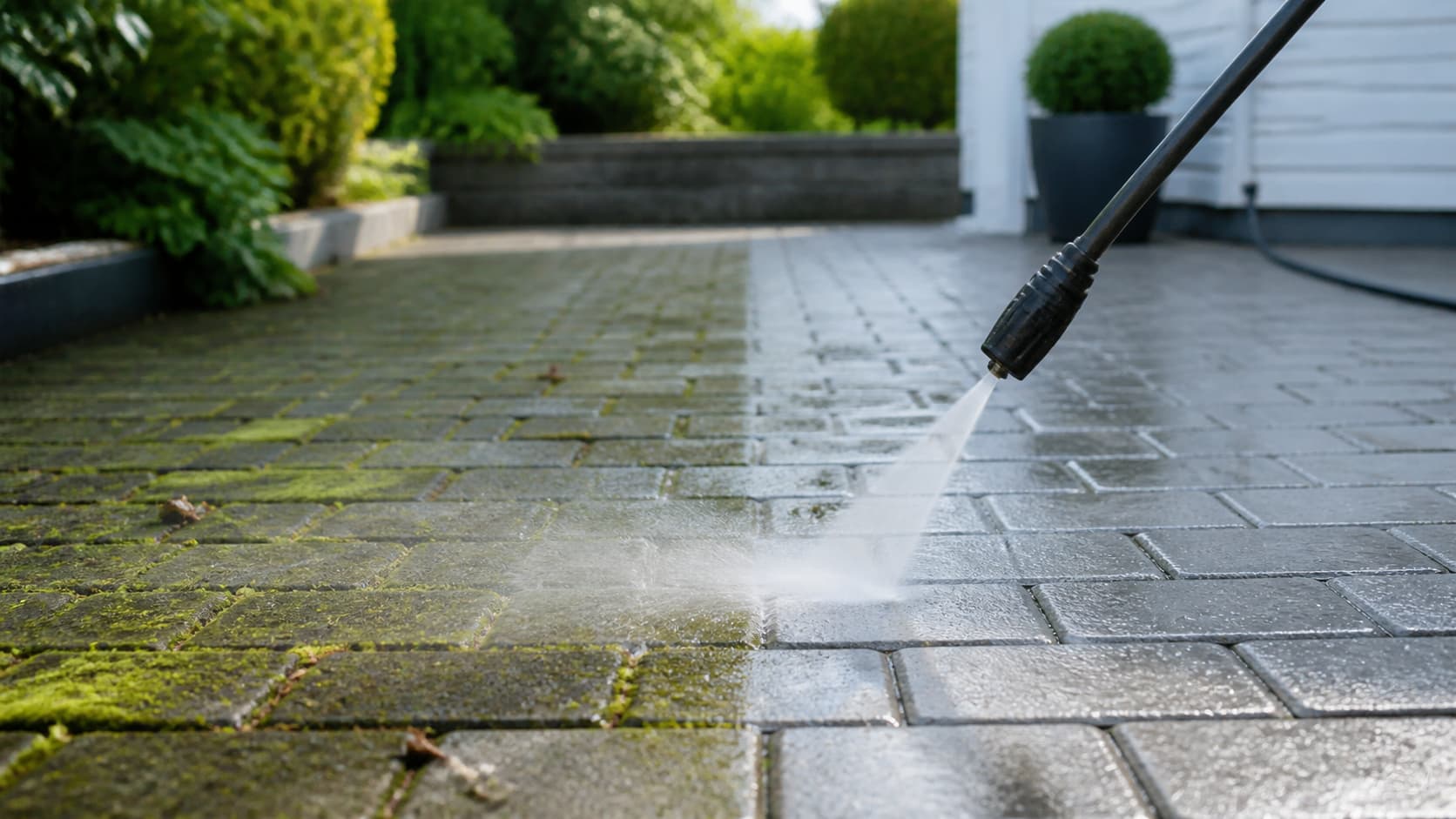
Pressure washing does one simple thing: it takes off the layer that does not belong on the surface — moss, algae, dust, pollen, mould and the grey crust that builds up over the years. Paving gets its colour back, a terrace stops being slippery, the green shadow disappears from the facade. The other half is just as simple: the wrong pressure and the wrong nozzle do damage in one afternoon that nobody can undo. The top skin of a concrete paver, the soft summer ring in a decking board and old render each react to a jet of water in their own way.
We wash paving stone and slabs, terraces, steps, plinths, facades, roofs, fences and railings in Tallinn and Harju County. Pressure washing paving is the most common of these jobs, and also the one most often done wrong.
The pressure is chosen for the surface, not for the machine
The same washer will clean granite and thirty-year-old render, except that the render ends up on the ground. So the order of work never changes: establish what the surface is, test a small area, and only then move onto the whole of it. Concrete maintenance guides recommend the same order and warn that a wet method used over loose debris that was not swept off dry first drives dirt into the pores of the concrete and leaves a patchy result.
Three things decide the outcome: the pressure, the water temperature and the angle of the nozzle. The nozzle is held at an angle and moved along the stone, not straight into the joint. Hot water lifts grease and biofilm at a lower pressure, which means less load on the surface.
The joint sand goes straight back in
This is where most self-washed driveways get damaged. Water, soil and seeds take the place of the sand washed out of the joint, the stones lose their side support and start to move under load.
Benders says it plainly in its paving maintenance guide: after washing you have to make sure the joints are still filled with sand and refill them if needed, because a sand-filled joint gives the paving a long life and keeps weeds from growing. Rudus says the same in its concrete surface guide: after pressure washing, check that the joint sand is there and refill the joints as soon as possible.
With us, re-sanding the joints is part of the job, not an extra. If a joint had already emptied over the years before the wash, we see it straight away and tell you how much extra sand it will take.
Moss comes back if the cause stays
Clean stone does not mean moss has stopped growing. Moss and algae live where there is damp and shade: a north wall, a path behind a dense hedge, a hollow the water does not drain from, the edge of a terrace where leaves fall. Washing removes the effect, not the cause.
So while we wash, we also look at what feeds the moss. Whether water stands, whether the falls carry it away from the house, whether the hedge needs cutting back so sunlight reaches the surface, whether the autumn leaves go uncollected. Sometimes the fix is a couple of hours of work, sometimes the falls have to be corrected: then we say so honestly beforehand and do that as separate work, under ground levelling.
There are products made for treating moss, and concrete manufacturers allow their use according to the product maker's instructions. We use them when the client wants it and when it is safe for the surface and the plants around it.
What we don't do with pressure
Honestly, the list of things to avoid matters as much as the cleaning itself:
- Strong acid and alkali. Concrete surface guides warn that strongly acidic or alkaline chemistry may well take the dirt off, but damages the cement matrix permanently. We use them only on individual stains and diluted, when nothing else works.
- A torch against weeds. Burning weeds out of the joint damages the surface of the stone and shortens its life; both Benders and Rudus say so. Weeds come out of the joint mechanically, root and all, and the joint is filled with sand.
- Sharp metal and crowbars. Blows and scraping leave marks on concrete that never go, and reduce the frost resistance of the stone.
- Washing very fresh paving at full pressure. On new paving the top skin is the most sensitive part, and that is where a whole layer comes off most easily.
If a surface is worn to the point where washing no longer helps, we say so before the work starts, not after the invoice.
When to wash in Estonia
The most logical time is spring, once the snow has gone: over the winter the surface collects grit, road salt and organic debris, and a spring wash puts the garden right in one go. The second good window is late summer and early autumn, when the surface still has time to dry properly before the cold. That matters if sealing or a protective treatment follows the wash, because those need a dry surface and temperatures above zero.
We do not pressure wash paving in winter. In frost the water freezes in the joints and on the surface; the result is dangerous and bad for the stone. The same goes for newly laid paving, which needs a season before its first wash.
How the work runs
The result starts with looking. We come out, go over the surface, measure the square metres and test a small area to see which method works. Only then do we give a price, say how long the work will take and whether a protective treatment makes sense on that surface.
On the day, we cover everything water and detergent must not touch: plants, doors, windows, lights and equipment. After washing we collect the loose material, sand the joints and leave the surface ready to walk on straight away.
We use the same equipment on roofs and facades, with a different method: there the pressure is low and the chemistry does the work. Washing and oiling a wooden terrace is a separate service, because oil needs a dry, warm surface; that is described under terrace maintenance. If the paving has settled so far that washing will not save it, we lay it again: see paving installation.
How often should paving be washed?
It depends on how shaded the spot is. A sunny driveway is fine for a couple of years; a shaded north-facing path grows moss every year. In between, what helps most is not letting leaves sit on the surface. We have written separately about year-round care: paving maintenance.
Does washing get the weeds out of the joints?
It takes the visible part; the roots stay. The lasting result comes when the joint is cleaned out and filled with sand: a full joint gives a seed nowhere to sit. There is more about that under weeding and pest control.
Is it worth sealing the stone after washing?
Sealing closes the pores of the concrete and keeps dirt on the surface, where it can be washed off. It makes sense when the surface is sound and dry and has not been covered with something a new layer will not sit on. We tell you on site whether it is worth it on your paving.
Do you wash apartment building car parks and common areas?
Yes. A housing association's grounds are washed the same way; we just agree separately on the times when the car park has to be free of cars. Ask for a quote through the enquiry form.
See our work
Photos from our own jobs, taken during the work and after it.