
Thuja planting and evergreen hedges
A hedge that closes into an even wall, not a row with gaps.
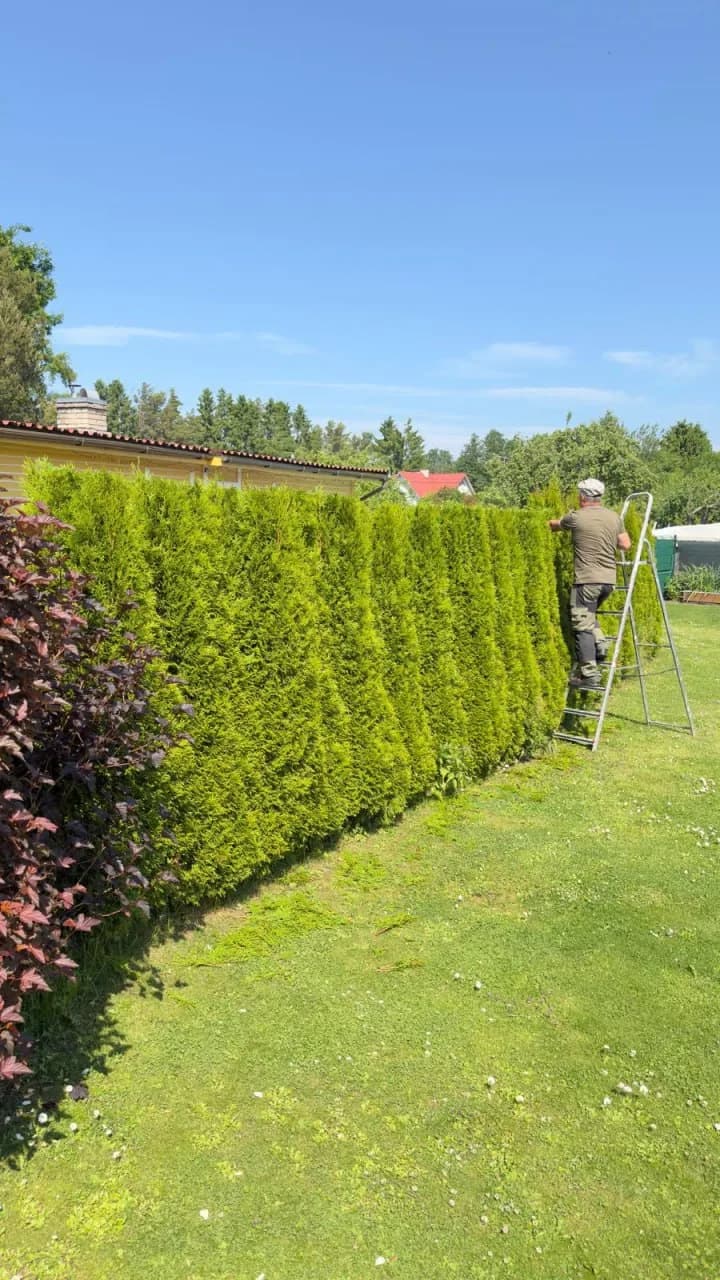
A thuja hedge is the only fence that closes itself up, as long as it went in correctly. It is also the only one that stays a gappy row for ten years if the plants were spaced too far apart, the root ball dried out during planting, or the hedge was put where water collects. We plant thuja (arborvitae, elupuu in Estonian) and build evergreen hedges in Tallinn and Harju County, in batches of one or two hundred plants, with the soil, the watering and the first year of care included.
Regular trimming is a separate service, described under conifer and hedge care.
How many plants per metre
It depends on the cultivar and on how fast you want a solid wall. The Royal Horticultural Society (RHS) hedge planting guide gives an in-row spacing of 30–60 cm, depending on the plant's final size and vigour. With the fast-growing Brabant we use the top of that range, with the slower Smaragd the bottom: the shoots knit together, but the plants do not start taking light and water from each other.
Two things often go wrong. The first is a row planted too tight, which within a couple of years forces you to cut the hedge back into old wood, and it will not grow again from there. The second is planting too close to the boundary: the RHS recommends setting a hedge about 90 cm inside the boundary line, because a hedge spreads sideways and will otherwise grow over your neighbour's ground or the pavement.
Brabant or Smaragd
These two are the most common thujas in Estonian gardens, and they behave completely differently.
Brabant grows fast: on RHS figures it reaches 4–8 m tall and 2.5–4 m wide in 5–10 years. It takes partial shade and is rated H7 for hardiness: hardy through the winter even in the harshest continental climates of Europe, below −20 °C. In return it wants trimming twice a season, or it goes bare at the base and climbs over the fence.
Smaragd grows slowly, holds a neat cone shape by itself and stays lower. It wants sun, and the RHS gives a separate warning that young plants have to be protected from drying winds. If you would rather not be out with a hedge trimmer every summer, Smaragd is the sounder choice, but the wall comes more slowly and you need more plants per metre.
Neither one is planted where water stands. Both want moist but free-draining soil, and standing water kills thuja roots more reliably than drought does.
The planting strip, the soil and the boundary
A hedge is not planted into separate holes but into a strip. The RHS guide says: dig over a strip 60–90 cm wide to a spade's depth and clear the weeds out of it. On ground that drains badly, the answer is to raise the soil into a ridge 15–20 cm high and 50–70 cm wide and plant into that.
One common mistake is digging organic matter into the bottom of the hole. The RHS puts it plainly: do not place organic material in the base of the trench, because it rots down and the plant sinks. Compost belongs mixed into the top layer of soil, not underneath the roots.
Planting depth is the second place where a hedge is quietly ruined. The root collar stays level with the ground, no deeper. On a container plant the tightly wound root ball has to be teased loose at the edges, or the roots keep circling and never move out into the surrounding soil.
Watering is the work of the first two years
A new hedge cannot take drought until its roots have grown out. The RHS is clear: keep the hedge well watered for two years after planting, and keep the soil of container plants moist but not waterlogged.
In Estonian conditions the watering that matters most is the one that goes on before the frost. In autumn, with the leaves down and the ground still unfrozen, thuja carries water into the winter. In winter the root draws nothing from frozen soil, while the foliage keeps losing water to sun and wind — that is where the brown spring hedge with perfectly healthy roots comes from. If watering tends to be forgotten, it is worth putting automatic irrigation under the hedge; a drip line along the row keeps working while you are away for two weeks.
Why thuja turns brown
The RHS guide to conifers lists the causes of browning as drought, cold, waterlogging and cold drying winds. In Estonia two more are local: road salt along the street and planting too deep.
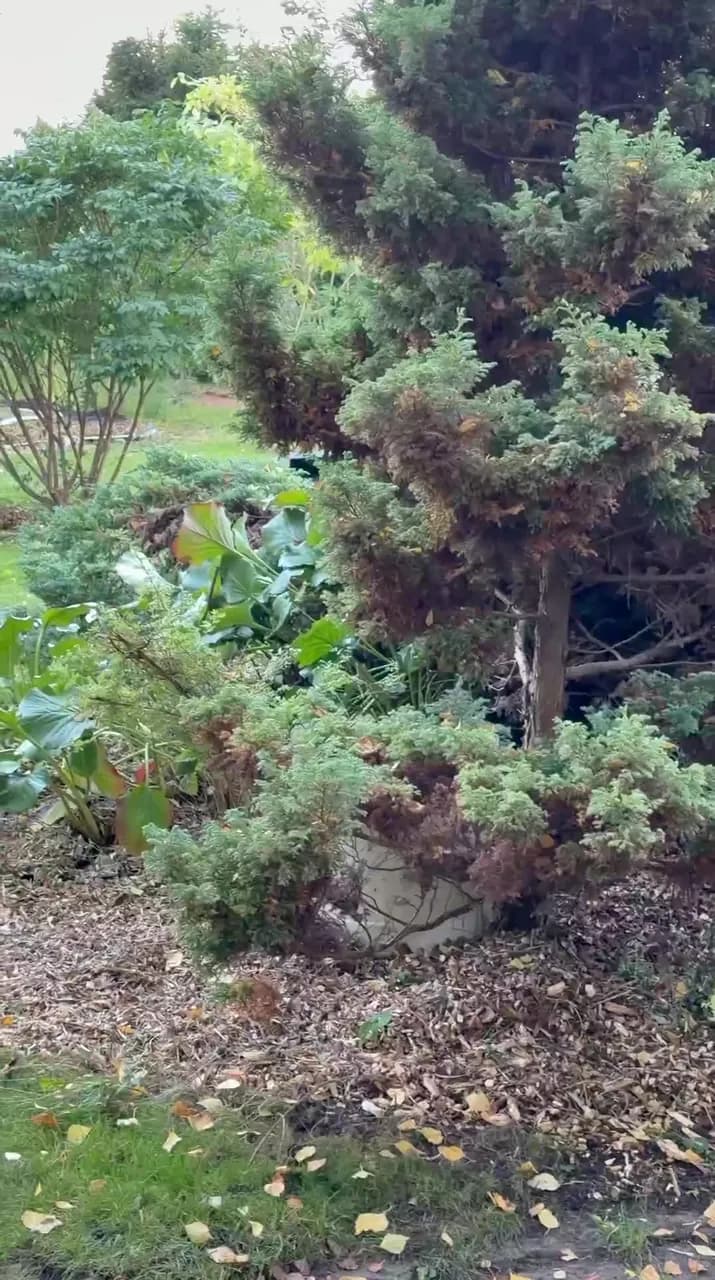
How to tell them apart. An evenly brown street-facing side usually means salt or wind. A plant browning from the bottom up, with a black and soft root collar, points to waterlogging or root rot. Patchy browning branch by branch can be fungal — for thujas the RHS names thuja blight and Coryneum canker. If only the inner, older needles are brown and the tips are green, that is the normal shedding of old foliage and nothing needs doing.
We have written about rescuing a browned hedge separately: why thuja turns brown and how to save it.
Trimming
The RHS recommends trimming thujas from April to the end of August; cutting outside that window is more likely to leave brown edges. The rule is simple: you cut young, green growth. Most conifers will not break new shoots from brown old wood, and thuja does it unreliably, so once a hedge has outgrown its space, cutting it back is no longer a safe route.
The hedge is shaped wider at the bottom than at the top. That way light reaches the lower branches too and the base does not go bare.
When to plant
Evergreens, according to the RHS, are best planted in early autumn: the ground is still warm, growth has stopped and the root has time to anchor before the frost. The second window is spring, as soon as the ground has thawed. The worst time is a dry July, when every missed watering shows immediately.
We bring the plants ourselves; cultivars, heights and quantities are agreed beforehand, see plant sourcing and delivery. If the hedge goes where an old fence or a line of stumps stands today, we take that work on as well.
How fast does the hedge close up?
With Brabant at 60 cm spacing and proper watering, you have a dense wall in three to four years. With Smaragd the same result takes longer, because the cultivar itself is slow, which is why it is planted closer together and often as a taller plant.
Can a hedge be planted in autumn once the ground is cold?
It can, until the ground is frozen. What matters is that the plant goes into winter with water in it and that the root ball does not dry out during planting.
What if one plant in the row dies?
We replace it and look at what is different about that spot: usually water collecting, planting too deep or a damaged root ball. A single gap in a row closes up only if the replacement is the same cultivar at a similar height.
How close to the boundary should the hedge go?
Leave close to a metre inside the boundary line, or in a couple of years the hedge will be growing on your neighbour's side and you will be maintaining it from both sides. We agree the exact line on site, ask for a quote.
See our work
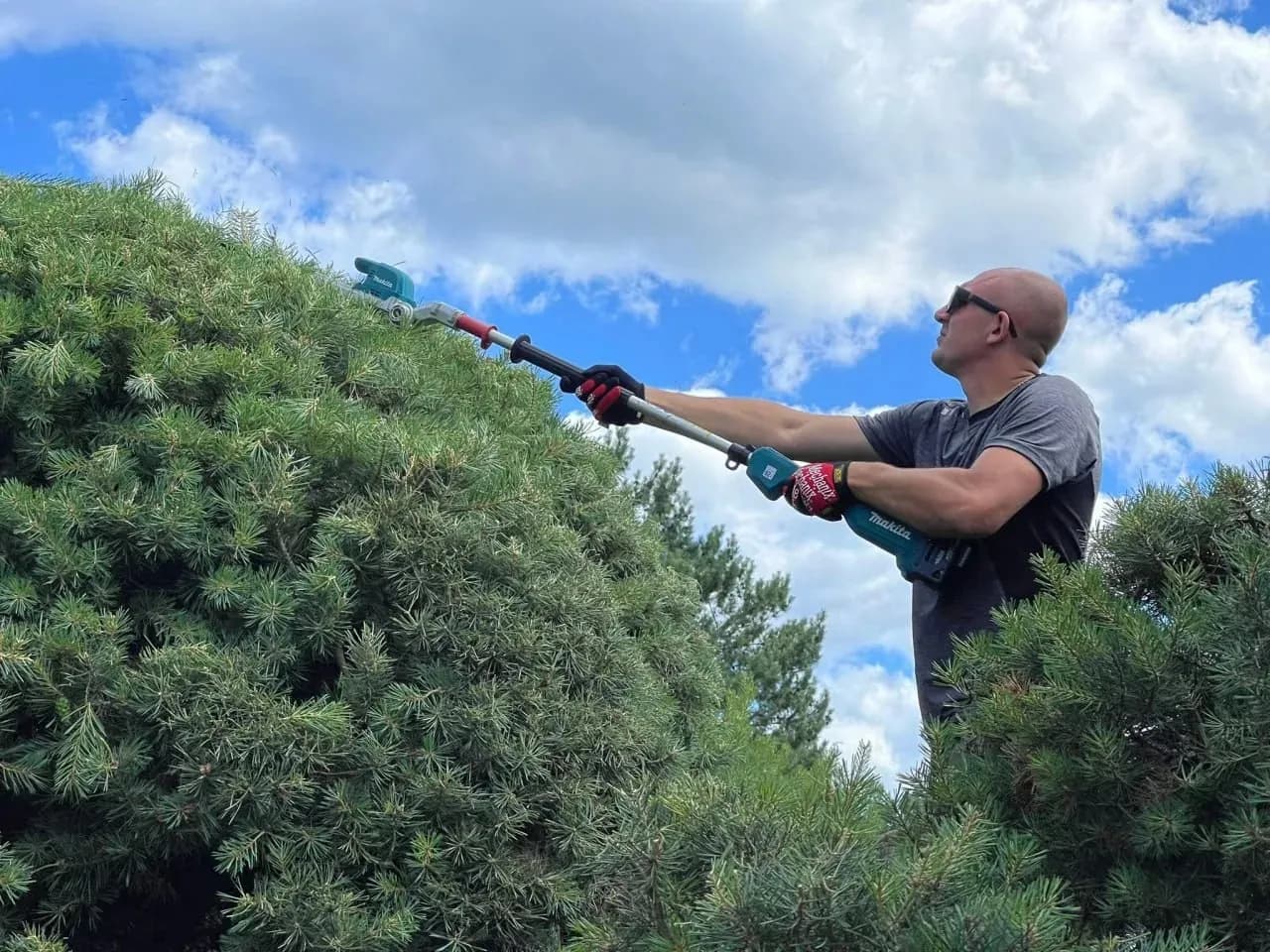
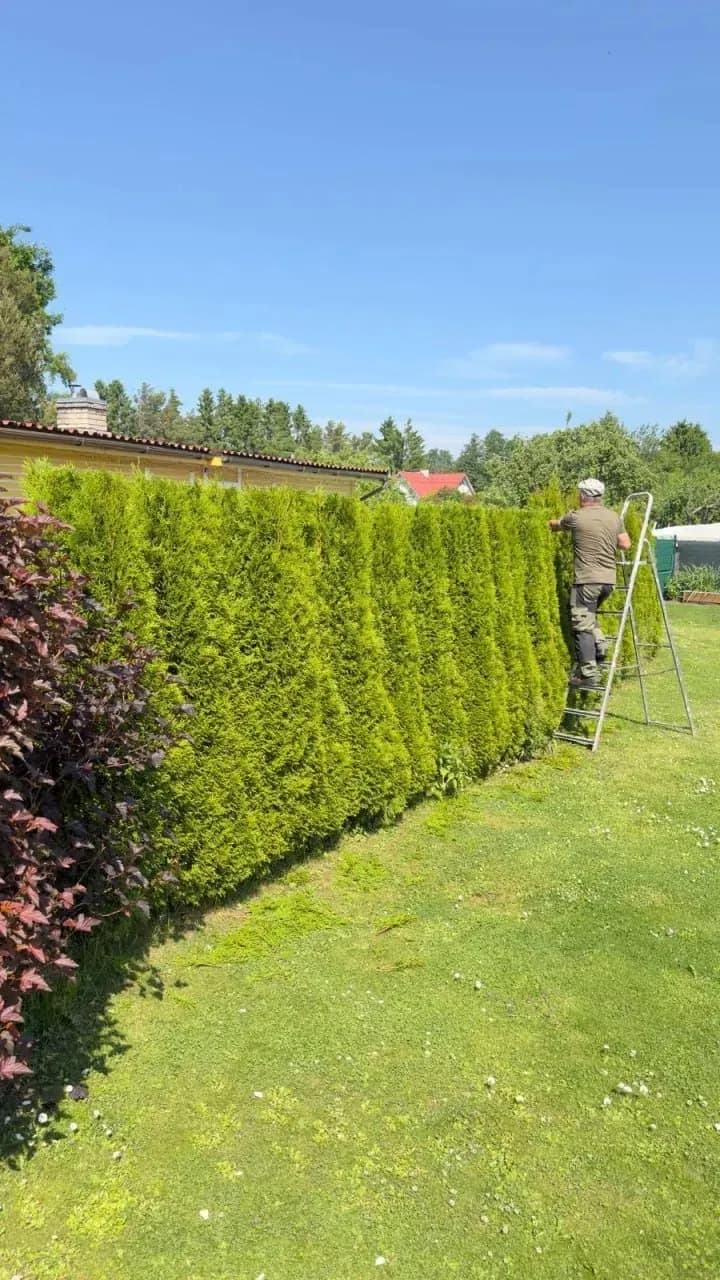
Photos from our own jobs, taken during the work and after it.
Our work
Why thuja turns brown and how to save it
Brown thuja branches are not always a death sentence. Six causes — from winter burn to fungus — and what to do in each case.
Read more