

Landscaping a new plot: where to start
The house is built; around it, construction soil and machine tracks. The right order of work so you do not redo everything twice.
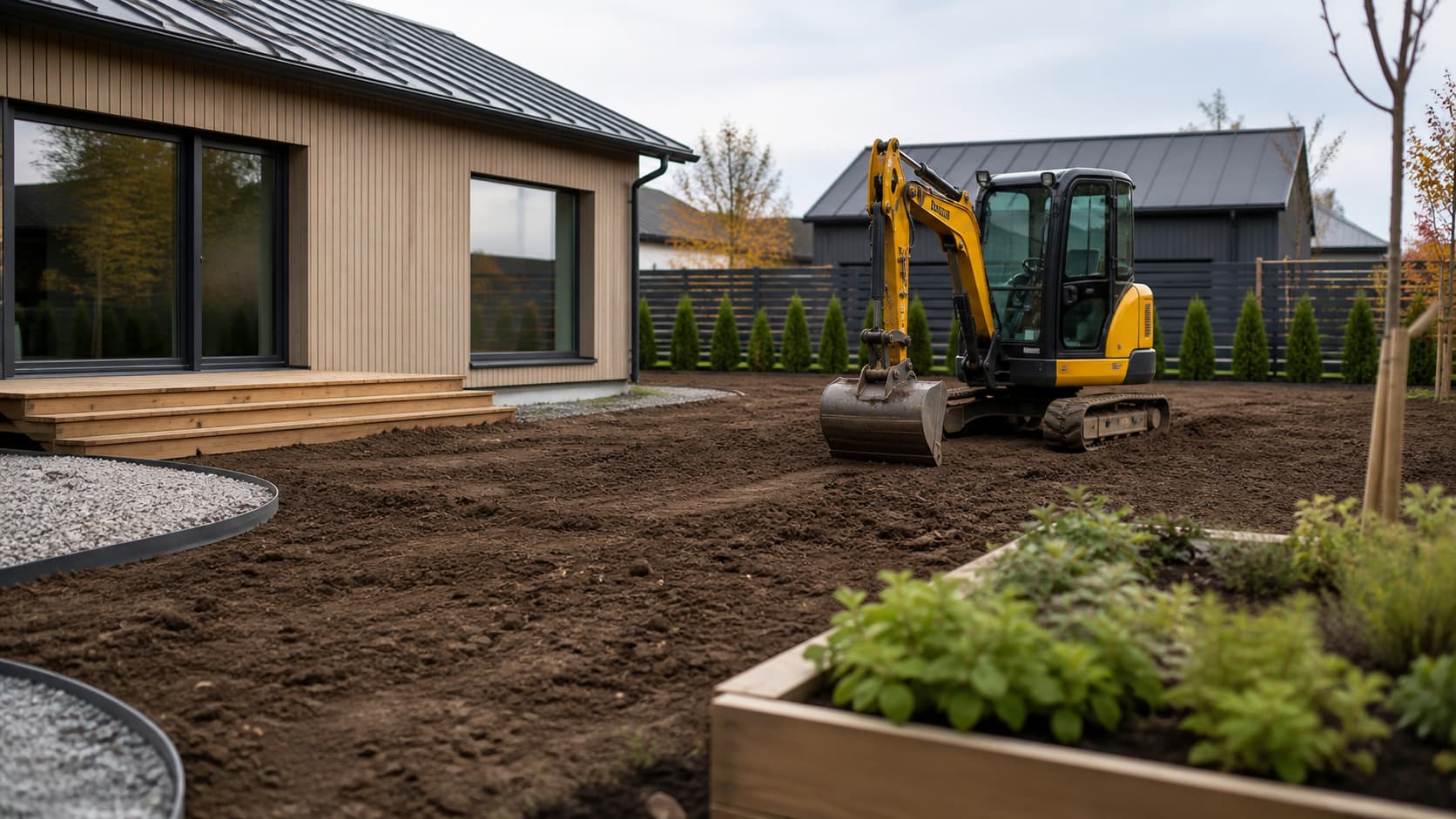
When house construction wraps up, the surrounding plot is usually left with machine-compacted clay or limestone fill, builder's rubble and standing puddles. The most expensive mistake a new homeowner can make at this stage is ordering a few loads of topsoil and sowing grass before levels, storm-water drainage, underground cables and paving are in place. Here is the six-step construction sequence we follow for landscaping a new plot in Tallinn and Harjumaa so you never have to dig up a finished lawn a year later.
Step 1: site clearing, tree removal and level planning
Before earthworks begin, inspect existing trees and site levels. Trees damaged during building or standing in the way of driveways are removed under tree felling and stumps are ground 20–30 cm below grade. At the same time, lock in the layout for parking, paths, terraces, outbuildings, play areas and boundary hedges.
Step 2: drainage, storm water, underground cables and irrigation pipes
Every underground pipe and conduit goes into the rough subgrade before topsoil arrives:
- rainwater downpipe connections and French drains, especially on heavy clay plots in Viimsi, Kakumäe, Rae and Harku;
- armoured cables in protective conduits for garden lighting, gate motors, robotic mower charging stations and garden houses;
- main supply lines and valve boxes for the automatic irrigation system.
Step 3: rough grading and falls away from the house
Compacted construction soil is ripped and loosened, concrete debris and boulders are cleared, and the subgrade is shaped with a positive fall (at least 1–2 cm per metre) away from the house foundation. Read more on our ground levelling and earthworks page.
Step 4: paving stones, kerbs and boundary fences
Driveways and paths require deep crushed-stone bases and heavy plate compactors. That is why paving stone installation, fence foundations and terrace piers always come before topsoil spreading. Installed concrete kerbs also give an exact finished edge to grade the lawn against.
Step 5: screened topsoil delivery and tree planting
Once heavy machinery leaves the plot, schedule screened topsoil and bulk material delivery. Spread and roll a 12–15 cm compacted layer of mineral topsoil for lawns, and excavate 40–60 cm deep trenches for hedges and perennial beds. Specimen trees and thuja hedges are planted at this stage.
Step 6: rolled turf or seeding, bed edging and mulching
Finally, lay rolled turf or sow grass seed, install bed edging, plant perennials and finish borders with pine bark mulch. We manage the entire process from initial layout to turnkey completion under landscaping services in Tallinn and Harjumaa.
Common questions
Can new-plot landscaping be split across two seasons to spread the cost?
Yes, staging the build over two years is very common. In year one, complete all underground conduits and drainage, rough grading, driveway paving and lawn installation so mud is eliminated around the house. Flower beds, ornamental shrubs and lighting fixtures can be added the following spring without digging up the lawn.
How much screened topsoil is needed for a new 1,000 m² plot?
If the house footprint, driveway and terrace cover 350 m² of a 1,000 m² plot, roughly 650 m² remains for lawn and planting beds. Allowing for a 15 cm settled depth and 20% compaction factor, a plot of that size typically takes 110 to 130 cubic metres of screened topsoil.
Do you need to excavate and haul away the existing site soil before bringing in topsoil?
Only if existing ground levels are already flush with kerbs and plinths or heavily contaminated with building rubble. Where finished levels allow raising the grade by 12 to 15 cm, we rip and contour the native mineral soil and spread screened topsoil directly on top.
Landscaping works
We visit your site, assess the scope and send a written offer. Free of charge and with no obligations.